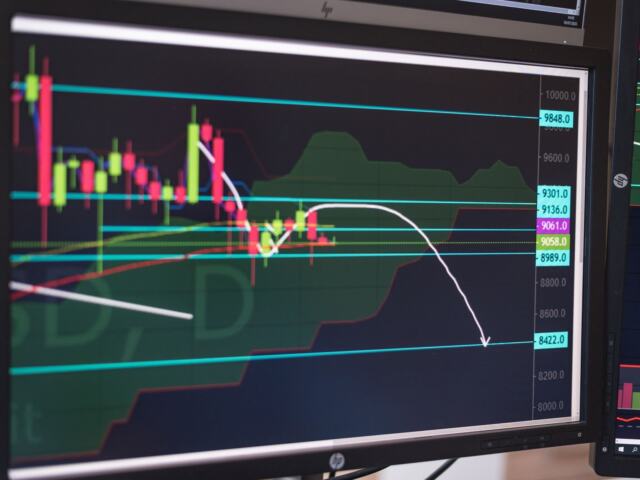
Picture wanting Bitcoin but fearing you will buy just before a drop. Dollar cost averaging crypto answers that worry by buying a fixed amount at regular intervals, which spreads your entry price across many days but does not prevent losses.
The idea is simple, yet it attracts several myths. This guide explains the mechanism, works through the figures from published examples, and covers setup and fees. If you are still choosing a platform, start with how to buy cryptocurrency.
How dollar-cost averaging works in crypto
Dollar-cost averaging (DCA) means committing a fixed amount of money to a particular cryptocurrency at regular intervals, regardless of the asset’s price. BitPay describes it as making smaller, equal investments on an ongoing basis, instead of large or irregular buys.
Because the amount is fixed, each purchase buys more units when the price is low and fewer when it is high. YouHodler summarises this as buying more when prices are low and less when they are high. That is why DCA suits volatile assets such as Bitcoin, where the price can swing sharply between one purchase and the next.
The contrast with lump sum investing, where all the money goes in at once, is the source of most confusion.
| Feature | Dollar-cost averaging | Lump sum investing |
|---|---|---|
| How money goes in | Equal amounts at regular intervals | One purchase at a single moment |
| Price exposure | Entry price is spread over many purchase dates | Holdings are pegged to the price from the day of purchase |
| What it needs to work | Price dips or swings after you start | Correct market timing, which is very hard to do |
| Where it can lag | A fast-rising market, where you keep buying at higher prices | A purchase made near a peak |
The comparison draws on BitPay’s DCA explainer and YouHodler’s guide.
Average cost basis and the formula
Cost basis is the cost of an asset when you make your purchase. With DCA you have many purchases, so you track an average cost basis instead.
The formula, as CoinCodex’s calculator explains, is the total amount spent divided by the total number of units purchased. A stock example on the same page shows $300 invested for 8.5 shares, an average of about $35.29 per share. Use that division rather than averaging the price list by eye, because it accounts for how many units each purchase actually bought.
A five-buy Bitcoin illustration
The equal dollar amount did the work, and no forecast was involved. Run the example through the formula yourself to see how the low-price buys pull the average cost down.
Common misunderstandings about DCA
“DCA protects me from losses”
It does not. It reduces the size of losses without removing them. YouHodler’s example has $100 invested weekly for 52 weeks into a market that then falls 50%. The total is worth $2,600, which it calls still a significant loss. DCA changes your entry price. It does nothing to the direction of the market.
“DCA always beats lump sum investing”
It does not. DCA aims for a lower average cost per unit than a lump sum made at an unfavourable peak. That is a goal in specific conditions, not a promise. YouHodler also warns that DCA can work against you if the market is rising quickly, because you keep buying at higher prices while part of your money waits.
A lump sum has its own condition. BitPay notes that gains from a lump sum after a downturn require successfully timing the market. So DCA suits people who do not want to bet on one entry date, and a lump sum suits those confident the price will rise soon. Few can judge that reliably.
“Small buys cost nothing extra”
They can cost more than you expect. Exchanges won’t always have the best rates and can add costly fees on top of each buy. The next section covers how that interacts with buying frequency.
What real Bitcoin prices show about volatility
CoinCodex publishes monthly Bitcoin prices from January 2020 to October 2026. They show why the timing of a single purchase matters. Bitcoin stood at $57,914 in May 2021 and $35,879 in June 2021, a monthly change of -38.05%. It reached $48,786 in December 2021, then $19,526 in July 2022, a -37.52% monthly change.
A lump sum placed at the May 2021 level would have been exposed to that drop in full. A scheduled buyer kept buying through it at lower prices. That is where DCA helped most in this period.

CoinCodex’s calculator also ran a plan of $10,000 initial plus $100 monthly over the same window. It shows $18,200 invested, 1.61 BTC bought and a final portfolio value of $138,696. Treat that result as hindsight for one start date, not a forecast. It also blends a lump sum with recurring buys, since the initial $10,000 went in at once. Where prices rise steadily, an early lump sum tends to look better in hindsight, as the warning about fast-rising markets suggests.

How to DCA into Bitcoin
Most people automate DCA with a recurring buy. Many exchanges and platforms allow you to set up recurring buys, which makes DCA effortless once configured. A recurring buy is simply a scheduled order for a set amount.
- Choose the asset. Pick Bitcoin if that is your target. Diamond Pigs lists Bitcoin, Ethereum or a diversified index fund as examples of what a plan can specify.
- Set the amount. Enter a fixed sum of currency you can commit without needing it back soon.
- Select the frequency. Choose from the intervals your exchange offers.
- Check funding and fees. Confirm where the money comes from and what each buy costs before you finalise the plan.
- Confirm and review. Let the schedule run, and check it periodically rather than reacting to each price move.
Coins you accumulate need somewhere to live. See our guide to crypto wallet for beginners for storage options.
Choosing a buying frequency and watching fees
Exchanges commonly offer weekly, bi-weekly or monthly purchases, and some exchanges offer daily buys. No supplied evidence shows one interval clearly outperforming another, so choose one you can sustain.
Fees tilt the choice. OneKey warns that frequent purchases can mean higher cumulative fees, so it recommends platforms with low or transparent charges. When each recurring buy carries a fee, fewer and larger purchases cost less in total, so weekly or monthly is the safer default. Choose daily only if the platform’s fee on each buy is low and clear. Check the fee page of your exchange before you commit, since fee structures vary between platforms.

Is DCA worth it in crypto?
DCA is worth it if your goal is to remove timing decisions and lessen the sting of a bad entry, not to maximise returns. OneKey says regular investments can potentially lower the average cost of acquiring cryptocurrencies. The key word is potentially.
- It suits people investing from regular income who find one big purchase stressful, or who expect volatility.
- It suits less anyone expecting protection in a falling market, or anyone sure prices are about to rise quickly.
- It needs discipline. The plan only works if the schedule continues through drops, and fees remain low enough not to eat the benefit.
If you would rather time trades actively, a different approach applies. Our guide on how to day trade crypto covers it, with a very different risk profile.
Frequently asked questions
| Question | Answer |
|---|---|
| What is cost basis? | It is the cost of an asset when you purchase it. With DCA, you calculate an average across all your buys. |
| Is DCA only for Bitcoin? | No. A recurring plan can target Bitcoin, Ethereum or a diversified index fund, according to Diamond Pigs. |
| Does DCA guarantee a lower average cost? | No. Regular buying can potentially lower average cost, but there is no guarantee, and the result depends on how prices move after you start. |
| Does a recurring buy need manual action each time? | No. Once set up on an exchange that supports it, the purchases run automatically at the chosen interval. |